4 Haziran 2012 Pazartesi

Die Brücke


Die Brücke (The Bridge) was a group of German expressionist artists formed in Dresden in 1905, after which the Brücke Museum in Berlin was named. Founding members were Fritz BleylErich HeckelErnst Ludwig Kirchner and Karl Schmidt-Rottluff. Later members were Emil NoldeMax Pechstein and Otto Mueller. The seminal group had a major impact on the evolution of modern art in the 20th century and the creation of expressionism.
Die Brücke is sometimes compared to the Fauves. Both movements shared interests in primitivist art. Both shared an interest in the expressing of extreme emotion through high-keyed color that was very often non-naturalistic. Both movements employed a drawing technique that was crude, and both groups shared an antipathy tocomplete abstraction. The Die Brücke artists' emotionally agitated paintings of city streets and sexually charged events transpiring in country settings make their French counterparts, the Fauves, seem tame by comparison.

History

The founding members of Die Brücke in 1905 were four Jugendstil architecture students: Fritz Bleyl (1880–1966), Erich Heckel (1883–1970), Ernst Ludwig Kirchner(1880–1938) and Karl Schmidt-Rottluff (1884–1976). They met through the Königliche Technische Hochschule (technical university) of Dresden, where Kirchner and Bleyl began studying in 1901 and became close friends in their first term. They discussed art together and also studied nature, having a radical outlook in common. Kirchner continued studies in Munich 1903–1904, returning to Dresden in 1905 to complete his degree. The institution provided a wide range of studies in addition to architecture, such as freehand drawing, perspective drawing and the historical study of art. The name "Die Brücke" was intended to "symbolize the link, or bridge, they would form with art of the future".
Die Brücke aimed to eschew the prevalent traditional academic style and find a new mode of artistic expression, which would form a bridge (hence the name) between the past and the present. They responded both to past artists such as Albrecht DürerMatthias Grünewald and Lucas Cranach the Elder, as well as contemporary international avant-garde movements.[4] The group published a broadside called Programme in 1906, where Kirchner wrote:
We call all young people together, and as young people, who carry the future in us, we want to wrest freedom for our actions and our lives from the older, comfortably established forces.
As part of the affirmation of their national heritage, they revived older media, particularly woodcut prints. The group developed a common style based on vivid color, emotional tension, violent imagery, and an influence from primitivism. After first concentrating exclusively on urban subject matter, the group ventured into southern Germany on expeditions arranged by Mueller and produced more nudes and arcadian images. They invented the printmaking technique of linocut, although they at first described them as traditional woodcuts, which they also made.
The group members initially "isolated" themselves in a working-class neighborhood of Dresden, aiming thereby to reject their own bourgeois backgrounds. Erich Heckel was able to obtain an empty butcher's shop on the Berlinerstrasse in Friedrichstadt for their use as a studio. Bleyl described the studio as:
that of a real bohemian, full of paintings lying all over the place, drawings, books and artist’s materials — much more like an artist’s romantic lodgings than the home of a well-organised architecture student.
Painting of the group members by Ernst Ludwig Kirchner 1926/7
Kirchner's became a venue which overthrew social conventions to allow casual love-making and frequent nudity. Group life-drawing sessions took place using models from the social circle, rather than professionals, and choosing quarter-hour poses to encourage spontaneity. Bleyl described one such model, Isabella, a fifteen-year-old girl from the neighbourhood, as "a very lively, beautifully built, joyous individual, without any deformation caused by the silly fashion of the corset and completely suitable to our artistic demands, especially in the blossoming condition of her girlish buds."
The group composed a manifesto (mostly Kirchner's work), which was carved on wood and asserted a new generation, "who want freedom in our work and in our lives, independence from older, established forces."
Otto Mueller, 1912
In September and October 1906, the first group exhibition was held, focused on the female nude, in the showroom of K.F.M. Seifert and Co. in Dresden.
Emil Nolde (1867–1956) and Max Pechstein (1881–1955) joined the group in 1906. Bleyl married in 1907, and, with a concern to support his family, left the group. Otto Mueller (1874–1930) joined in 1910.
Between 1907 and 1911, Brücke members stayed during the summer at the Moritzburg lakes and on the island ofFehmarn. In 1911, Kirchner moved to Berlin, where he founded a private art school, MIUM-Institut, in collaboration with Max Pechstein with the aim of promulgating "Moderner Unterricht im Malen" (modern teaching of painting). This was not a success and closed the following year.
In 1913, Kirchner wrote Chronik der Brücke (Brücke chronicle), which led to the ending of the group.


Les Fauves

Fauvism is the style of les Fauves (French for "the wild beasts"), a short-lived and loose group of early twentieth-century Modern artists whose works emphasized painterly qualities and strong color over the representational or realistic values retained by Impressionism. While Fauvism as a style began around 1900 and continued beyond 1910, the movement as such lasted only a few years, 1904–1908, and had three exhibitions. The leaders of the movement were Henri Matisse and André Derain.


Artists and style

Besides Matisse and Derain, other artists included Albert MarquetCharles CamoinLouis Valtat, the Belgian painter Henri EvenepoelMaurice Marinot,Jean PuyMaurice de VlaminckHenri ManguinRaoul DufyOthon FrieszGeorges Rouault, the Dutch painter Kees van Dongen, the Swiss painterAlice Bailly, and Georges Braque (subsequently Picasso's partner in Cubism).
The paintings of the Fauves were characterized by seemingly wild brush work and strident colors, while their subject matter had a high degree of simplification and abstraction. Fauvism can be classified as an extreme development of Van Gogh's Post-Impressionism fused with the pointillism of Seurat and other Neo-Impressionist painters, in particular Paul Signac. Other key influences were Paul Cézanne and Paul Gauguin, whose employment of areas of saturated color—notably in paintings from Tahiti—strongly influenced Derain's work at Collioure in 1905. In 1888 Gauguin had said to Paul Sérusier:
How do you see these trees? They are yellow. So, put in yellow; this shadow, rather blue, paint it with pure ultramarine; these red leaves? Put in vermilion.
Fauvism can also be seen as a mode of Expressionism.

Origins

Gustave Moreau was the movement's inspirational teacher; a controversial professor at the École des Beaux-Arts in Paris and a Symbolist painter, he taught Matisse, Marquet, Manguin, Rouault and Camoin during the 1890s, and was viewed by critics as the group's philosophical leader until Matisse was recognized as such in 1904. Moreau's broad-mindedness, originality and affirmation of the expressive potency of pure color was inspirational for his students. Matisse said of him, "He did not set us on the right roads, but off the roads. He disturbed our complacency." This source of empathy was taken away with Moreau's death in 1898, but the artists discovered other catalysts for their development.
In 1896, Matisse, then an unknown art student, visited the artist John Peter Russell on the island of Belle Îleoff Brittany. Russell was an Impressionist painter; Matisse had never previously seen an Impressionist work directly, and was so shocked at the style that he left after ten days, saying, "I couldn't stand it any more." The next year he returned as Russell's student and abandoned his earth-colored palette for bright Impressionist colors, later stating, "Russell was my teacher, and Russell explained colour theory to me." Russell had been a close friend of Vincent van Gogh and gave Matisse a Van Gogh drawing.
In 1901, Maurice de Vlaminck encountered the work of Van Gogh for the first time at an exhibition, declaring soon after that he loved Van Gogh more than his own father; he started to work by squeezing paint directly onto the canvas from the tube.
In parallel with the artists' discovery of contemporary avant-garde art came an appreciation of pre-Renaissance French art, which was shown in a 1904 exhibition, French Primitives. Another aesthetic feeding into their work was African sculpture, which Vlaminck, Derain and Matisse were early collectors of.
Many of the Fauve characteristics first cohered in Matisse's painting, Luxe, Calme et Volupté ("Luxury, Calm and Pleasure"), which he painted in the summer of 1904, whilst in Saint-Tropez with Paul Signac and Henri-Edmond Cross.

[edit]Salon D'Automne 1905

The artists shared their first exhibition at the 1905 Salon d'Automne. The group gained their name, after critic Louis Vauxcelles described their show of work with the phrase "Donatello au milieu des fauves!" ("Donatello among the wild beasts"), contrasting the paintings with a Renaissance-type sculpture that shared the room with them. Henri Rousseau was not a Fauve, but his large jungle scene The Hungry Lion Throws Itself on the Antelope was exhibited near Matisse's work and may have had an influence on the pejorative used. Vauxcelles' comment was printed on 17 October 1905 in Gil Blas, a daily newspaper, and passed into popular usage. The pictures gained considerable condemnation, such as "A pot of paint has been flung in the face of the public" from the critic Camille Mauclair (1872–1945), but also some favorable attention. The painting that was singled out for attacks was Matisse's Woman with a Hat, which was bought by Gertrude and Leo Stein: this had a very positive effect on Matisse, who was suffering demoralization from the bad reception of his work.

3 Haziran 2012 Pazar

Phalanx


The Phalanx are a fictional cybernetic species in the Marvel Comics universe. They have come in conflict with the X-Men and related groups on several occasions. They form a hive mind, linking each member by a telepathy-like system.
The Phalanx were created by writer Scott Lobdell and given definitive design by artist Joe Madureira.[citation needed] They owe much in concept and appearance to the original Technarchy (by writer Chris Claremont and artist Bill Sienkiewicz). Although appearing in prototype variations in earlier issues, the Phalanx first appeared in their full form in Uncanny X-Men #312 (May 1994).[citation needed]
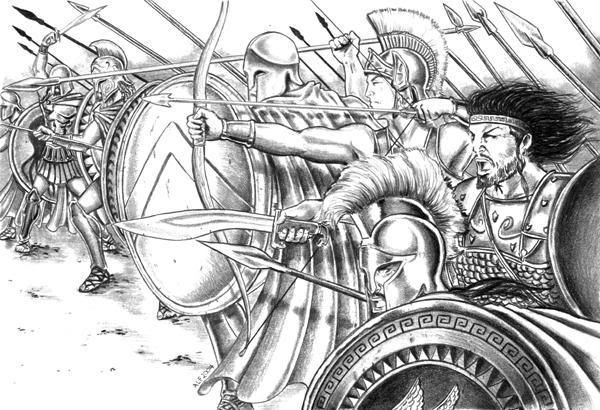
The term phalanx (Greek: φάλλαγα, phālanga) (plural phalanxes or phalanges (Greek: φάλλαγες, phālanges)) is a rectangular military formation, usually composed entirely of heavy infantry armed with spears, pikes, or similar weapons, particularly in Ancient Greek warfare. The term can also refer more generally to a wall of separate parts which forms a whole unit, and it is in this sense that it fits the fictional alien race.

Origins

Phalanx are formed when organic lifeforms are infected with the Technarchy's techno-organic transmode virus. They pass through a lifecycle attempting to infect others before reaching critical mass. At that time, by hard-wired instruction, they build a "Babel Spire" to contact the Technarchy. The Technarchy, however, consider Phalanx to be abominations. They invariably destroy the Phalanx "nest", usually by converting the entire planet into techno-organic matter and draining its energy.


Expressionism

A term used to denote the use of distortion and exaggeration for emotional effect, which first surfaced in the art literature of the early twentieth century. When applied in a stylistic sense, with reference in particular to the use of intense colour, agitated brushstrokes, and disjointed space. Rather than a single style, it was a climate that affected not only the fine arts but also dance, cinema, literature and the theatre.


Expressionism is an artistic style in which the artist attempts to depict not objective reality but rather the subjective emotions and responses that objects and events arouse in him. He accomplishes his aim through distortion, exaggeration, primitivism, and fantasy and through the vivid, jarring, violent, or dynamic application of formal elements. In a broader sense Expressionism is one of the main currents of art in the later 19th and the 20th centuries, and its qualities of highly subjective, personal, spontaneous self-expression are typical of a wide range of modern artists and art movements.
Unlike Impressionism, its goals were not to reproduce the impression suggested by the surrounding world, but to strongly impose the artist's own sensibility to the world's representation. The expressionist artist substitutes to the visual object reality his own image of this object, which he feels as an accurate representation of its real meaning. The search of harmony and forms is not as important as trying to achieve the highest expression intensity, both from the aesthetic point of view and according to idea and human critics.
Expressionism assessed itself mostly in Germany, in 1910. As an international movement, expressionism has also been thought of as inheriting from certain medieval artforms and, more directly, Cézanne, Gauguin, Van Gogh and the fauvism movement.
The most well known German expressionists are Max Beckmann, Otto Dix, Lionel Feininger, George Grosz, Ernst Ludwig Kirchner, August Macke, Emil Nolde, Max Pechstein; the Austrian Oskar Kokoschka, the Czech Alfred Kubin and the Norvegian Edvard Munch are also related to this movement. During his stay in Germany, the Russian Kandinsky was also an expressionism addict.

Expressionism was a modernist movement, initially in poetry and painting, originating in Germany at the beginning of the 20th century. Its typical trait is to present the world solely from a subjective perspective, distorting it radically for emotional effect in order to evoke moods or ideas.[1][2] Expressionist artists sought to express meaning[3] or emotional experience rather than physical reality.[3][4]
Expressionism was developed as an avant-garde style before the First World War. It remained popular during the Weimar Republic,[1] particularly in Berlin. The style extended to a wide range of the arts, including paintingliteraturetheatredancefilmarchitecture and music.
The term is sometimes suggestive of emotional angst. In a general sense, painters such as Matthias Grünewald and El Greco are sometimes termed expressionist, though in practice the term is applied mainly to 20th-century works. The Expressionist emphasis on individual perspective has been characterized as a reaction to positivism and other artistic styles such as naturalism and impressionism.[5]


Jugendstil


Art Nouveau (French pronunciation: [aʁ nuvo]Anglicised to /ˈɑːrt nˈv/) is an international philosophy[1] and style of art, architecture and applied art—especially the decorative arts—that were most popular during 1890–1910.[2] The name "Art Nouveau" is French for "new art". It is known also asJugendstilpronounced [ˈjuːɡn̩tʃtiːl ], German for "youth style", named after the magazine Jugend, which promoted it, as Modern (Модерн) in Russia, perhaps named after Parisian gallery "La Maison Moderne", as Secession in Austria-Hungary and its successor states after the Viennese group of artists, and, in Italy, as Stile Liberty from the department store in London, Liberty & Co., which popularised the style. A reaction to academic art of the 19th century, it was inspired by natural forms and structures, not only in flowers and plants but also in curved lines. Architects tried to harmonize with the natural environment. It is also considered a philosophy of design of furniture, which was designed according to the whole building and made part of ordinary life.[3]
The style was influenced strongly by Czech artist Alphonse Mucha, when Mucha produced a lithographed poster, which appeared on 1 January 1895 in the streets of Paris as an advertisement for the play Gismonda by Victorien Sardou, featuring Sarah Bernhardt.[4] It popularised the new artistic style and its creator to the citizens of Paris. Initially named Style Mucha, (Mucha Style), his style soon became known as Art Nouveau.[5]
Art Nouveau was most popular in Europe, but its influence was global. Hence, it is known in various guises with frequent localised tendencies.[6] In France,Hector Guimard's Paris metro entrances were of art nouveau style and Emile Gallé practised the style in NancyVictor Horta had a decisive effect on architecture in Belgium.[7] Magazines like Jugend helped publicise the style in Germany, especially as a graphic artform, while the Vienna Secessionistsinfluenced art and architecture throughout Austria-Hungary. Art Nouveau was also a style of distinct individuals such as Gustav KlimtCharles Rennie MackintoshAlphonse MuchaRené LaliqueAntoni Gaudí and Louis Comfort Tiffany, each of whom interpreted it in their own manner.[8][9]
Although Art Nouveau was replaced by 20th-century modernist styles,[10] it is considered now as an important transition between the historicism ofNeoclassicism and modernism.[9] Furthermore, Art Nouveau monuments are now recognised by UNESCO with their World Heritage List as significant contributions to cultural heritage.[11] The historic center of Riga, Latvia, with "the finest collection of art nouveau buildings in Europe", was included on the list during 1997 in part because of the "quality and the quantity of its Art Nouveau/Jugendstil architecture",[12] and four Brussels town houses by Victor Horta were included during 2000 as "works of human creative genius" that are "outstanding examples of Art Nouveau architecture brilliantly illustrating the transition from the 19th to the 20th century in art, thought, and society".

Origins

The origins of Art Nouveau are found in the resistance of the artist William Morris to the cluttered compositions and the revival tendencies of the 19th century and his theories that helped initiate the Arts and crafts movement.[24] However, Arthur Mackmurdo's book-cover for Wren's City Churches (1883), with its rhythmic floral patterns, is often considered the first realisation of Art Nouveau.[24] About the same time, the flat perspective and strong colors of Japanese wood block prints, especially those of Katsushika Hokusai, had a strong effect on the formulation of Art Nouveau.[25] The Japonisme that was popular in Europe during the 1880s and 1890s was particularly influential on many artists with its organic forms and references to the natural world.[25]Besides being adopted by artists like Emile Gallé and James Abbott McNeill Whistler, Japanese-inspired art and design was championed by the businessmen Siegfried Bing and Arthur Lasenby Liberty at their stores[26] in Paris and London, respectively.